04 August 2026
Regional biosecurity protects New Zealand’s primary sector from more than billion-dollar pest risk
A new independent report commissioned by the partnership of New Zealand’s 16 regional and unitary councils – Te Uru Kahika – reveals that regional biosecurity work delivers strong and consistent economic returns and warns that disruption during local government reform could risk New Zealand facing an estimated $1.7 billion in net costs.
The report, Benefits of regional and unitary council biosecurity interventions, prepared by Heuser|Whittington, draws on data from all 16 regional and unitary councils and reviews cost-benefit evidence from across the sector.
Te Uru Kahika Biosecurity Co-Sponsor and Canterbury Regional Council Chair Dr Deon Swiggs said the report gives everyone involved in reform a shared evidence base.
“Biosecurity is practical economic infrastructure for New Zealand. It protects farmers, growers, foresters, exporters, biodiversity and communities from costs that become much larger when pests are allowed to spread,” said Chair Swiggs.
“The report finds that regional and unitary councils invest around $142 million a year managing pests across 13.2 million hectares of productive land, helping protect a primary sector that contributes around $34 billion to New Zealand’s GDP.
“Structures may change through reform, but pests will not stop while we work through future local government arrangements. This report outlines why regional biosecurity capability needs to continue to be supported through transition and beyond,” said Chair Swiggs.
The report models a five-year disruption to regional biosecurity programmes and estimates a net cost of $1.7 billion from escalating pest damage and the cost of re-establishing control.
“It costs far less to keep pests under control than to try to regain control later.
“Regional and unitary councils have built biosecurity capability over decades. That includes field staff, pest data, surveillance, compliance tools, landowner relationships, local ecological knowledge, and the ability to coordinate across property boundaries and regions. That capability is also not easy to replace once lost,” said Chair Swiggs.
Te Uru Kahika Biosecurity Co-Sponsor and Hawke’s Bay Regional Council Chair Sophie Siers, who has a background in organic farming near Waimārama, says the value of regional biosecurity is clear to rural communities.
“When you farm, you learn that some problems are bigger than your fence line. For example, Chilean needle grass can move from farm to farm through livestock, hay and machinery. No individual landowner can solve that alone,” says Chair Siers, “That is why regional coordination matters. Councils can work across boundaries, bring landowners together, track where pests are moving, and keep pressure on pests before they become much more expensive to manage.
“We must also learn lessons from the past. When possum control lapsed in the 1970s, bovine TB resurged through the 1980s and 1990s. Regaining control cost far more than maintaining it would have,” said Chair Siers
Chair Siers says the report also highlights a funding mismatch that reform is an opportunity to fix.
“The benefits of this work are often national. Regional biosecurity supports productive land, export resilience, biodiversity, and New Zealand’s international reputation. But the report finds 78 percent of regional biosecurity costs are funded from council rates and regional revenue,” said Chair Siers.
The report also concludes major biodiversity gains delivered through the same field operations, and landowner relationships that support pest management. Councils reported co-benefits including kiwi population increases at monitored Horizons sites and a 370 percent increase in kōkako breeding pairs in Auckland’s Hūnua Ranges. These biodiversity benefits are not counted in the report’s headline economic figures, meaning the economic case is conservative.
Te Uru Kahika says the evidence should now inform how biosecurity functions are treated through reform, including future delivery models and a co-investment framework that better aligns funding with the beneficiaries of the work.
“This report establishes the value of regional biosecurity. The next step is to design a future system that protects that capability and funds it appropriately.
“We will work with Government, the primary sector, Ministry for Primary Industries, and Department of Conservation on the future of regional biosecurity for the good of New Zealand,” says Chair Swiggs.
Every quantitative cost-benefit analysis of terrestrial pest management reviewed found positive net benefits. In Canterbury and Otago alone, harmonised analysis found regional biosecurity programmes deliver around $2 billion in net benefits.
Te Uru Kahika is releasing the report to inform the next phase of local government reform and to invite central government, the primary sector, MPI and DOC to work with regional and unitary councils on how biosecurity should be delivered and funded in any future system.
ENDS
Media contact: Nicole Taber, Te Uru Kahika Communications Lead, 022 100 2422
About Te Uru Kahika
Te Uru Kahika – Regional and Unitary Councils Aotearoa is the partnership of New Zealand's 16 regional and unitary councils. We work together to protect and enhance our environment, build resilient communities, and support a thriving economy.
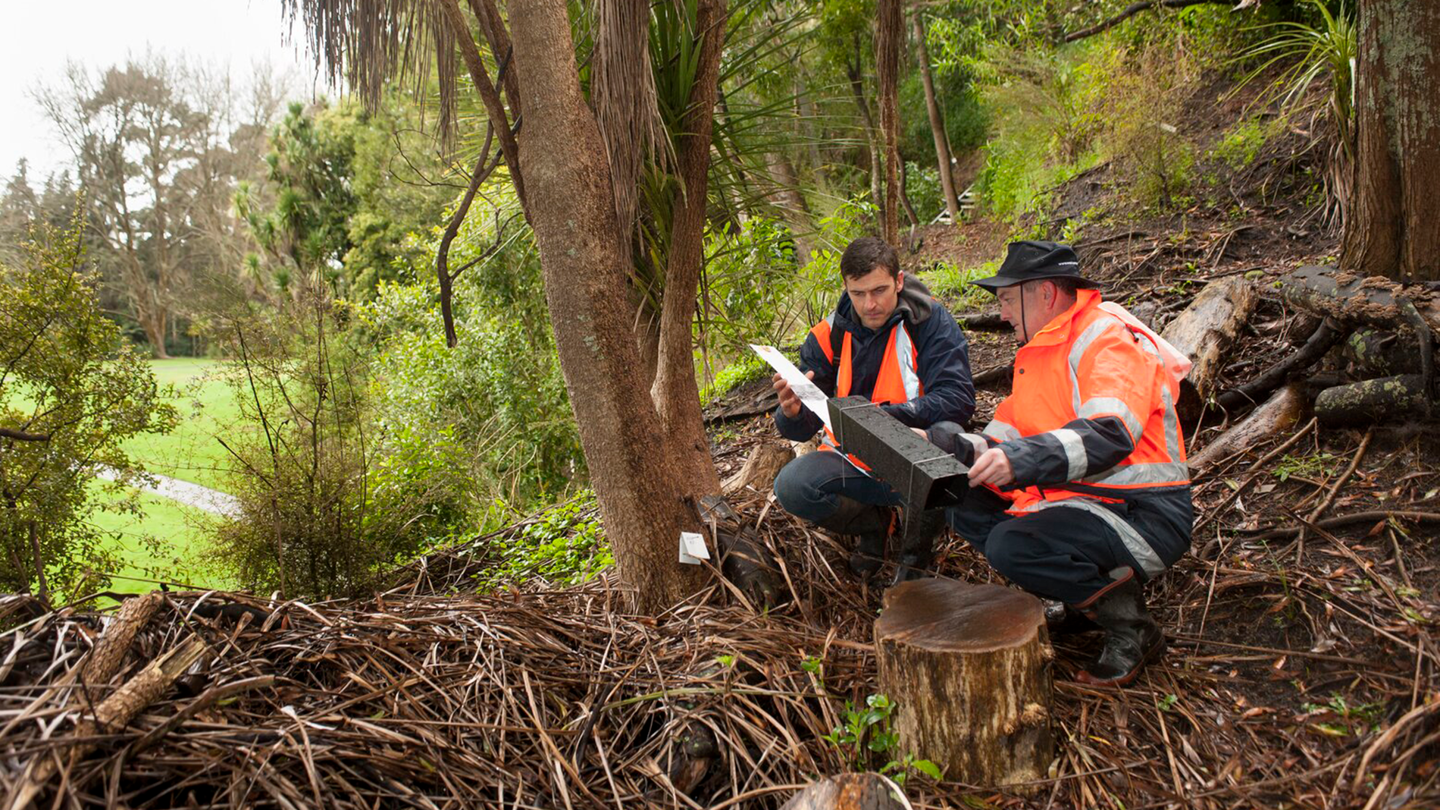
Trapping of invasive pest species is part of regional and unitary biosecurity work